



Training
We offer beginner’s classes twice a week where you can learn the basics that apply to more than one weapon type. As soon as you have internalised the fundamentals (after about half a year or one year), you can join the the intermediate classes for sword & buckler and/or rapier.
If you wanto to try out our classes, join a free introductory course on Saturday afternoon. You can find the dates at the top of our homepage. In a three-hour class, you learn the fundamentals of sword & buckler and rapier that will help you navigate the regular beginner’s classes. Your first regular week training with the group is free, too.
If this piques your interest, do not hesitate to get in touch with Cornelius via e-mail. No time on Saturdyas but still willing to give us a try? Let us know and we might be able to squeeze you in somewhere.
Previous training experience or equipment are not required. Just bring regular sports clothes (indoor shoes optional) and preferably a water bottle. Fencing masks and other safety equipment are only required from intermediate levels onwards.
We train in the practice room of Therapiezentrum Eilbek (Conventstrasse 12, 22089 Hamburg, ground floor), near public transport stations U Wartenau and S Landwehr. There is a small (!) parking lot in front of the building (only free for 2.5 hours max!). Inside the Therapiezentrum there are changing rooms, toilets and showers.
Classes and Schedule
Starting April 2026 we offer the following classes:
Monday
8:30–10 pm: Rapier
Wednesday
7–8:30 pm: Beginner’s class
8:30–10 pm: Sword & Buckler
Friday
7–10 pm: Sword & Buckler
Saturday
10–11:30 am: Beginner’s class
11:30 am–1 pm: Rapier
1–3 pm: Free training, time for individual lessons (unless cancelled)
Fares and Membership Fees
- Two-Classes Membership: € 35 per month (reduced fee € 25)
- Three-Classes Membership: € 45 per month (reduced fee € 35)
- Four-Classes Membership: € 55 per month (reduced fee € 40)
- Six-Classes Membership: € 60 per month (reduced fee € 45)
You can attend as many classes (60 minutes each, followed by individual practise) per week as are included in your membership, the only limitation being that intermediate classes are only for intermediate students. For beginners we therefore suggest obtaining a two-class membership or a ticket of ten classes. The free training class on Saturdays is included in these memberships if it takes place (which is often the case but not always). Membership plans run for a minimum of three months and can be cancelled with a three month's notice. They can be upgraded or downgraded for every next month.
Other offers:
- Single ticket of a group class (90 minutes or 120 for a free training class): € 15 (€ 12)
- Ticket of ten classes of group training: € 120 (€ 110)
- Individual lesson (60 minutes): € 50, specifics will be arranged beforehand; a discount will be granted for several lessons
- Seminars (e.g. for clubs) from 50 € per hour plus travel and accommodation costs if necessary; specifics and prices will be arranged beforehand
Reduced prices can be found in brackets and apply to pupils (from 14 years of age and with a signed permission from their parents or custodian [in German only]), university students, trainees (no interns) and those having a gap year to work in the social sector (Freiwiliges Soziales Jahr). Special arrangements are possible.
All this information is subject to change and supplied without liability. Upon the conclusion of a contract, the stipulated conditions apply. The complete terms and conditions can be downloaded here and the rules of conduct here (both in German only). If you have any questions, please do not hesitate to contact me: cornelius@dimicator-schola.com
Curriculum and philosophy
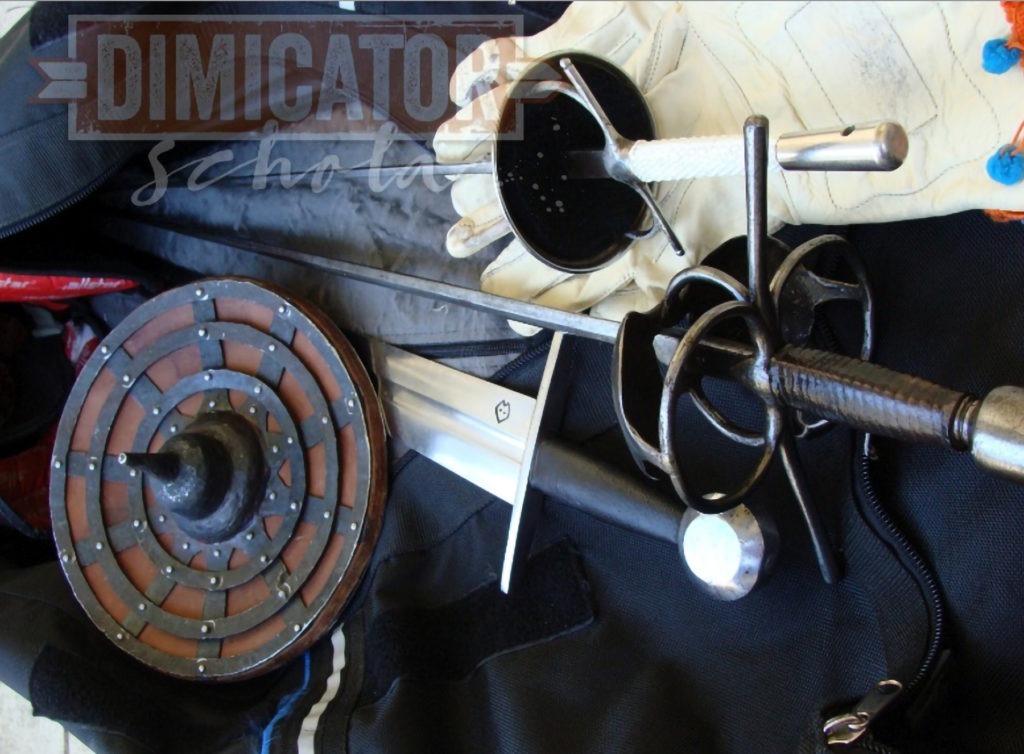
Dimicator Schola focuses on two main disciplines: The first is fighting with sword and buckler, a small and often round shield that was particularly popular in the 13th and 14th century. We suspect that this popularity was partly due to the fact that armoured warriors fought similarly with their triangular shields during this period. Therefore, we also use the larger shields from time to time. Buckler fighting itself is more complex than many other disciplines because of the two weapons used in parallel, but if you have some experience in it, you can easily transfer this knowledge to other weapons. There are even many parallels to modern Olympic fencing.
Our second focus is fighting with the rapier from around the year 1600. It is not fundamentally easier; the weapons, for example, weigh about the same as arming swords. But just as fighting with bucklers, rapier fighting is quick, effective and elegant if you do it correctly.
Our source material is historical, but the training methods are modern and safe. We strive for a training environment that is characterized by helpfulness, respect and tolerance. We learn and practise together; nobody is chastised for a slow learning process or making mistakes (unless of course they were caused by violating the safety regulations). Mistakes are useful, as they allow us to learn from them. When problems arise, we try to address them immediately and take both factual and human circumstances into account when solving them. We do not tolerate any discrimination against, or segregation of, any person or group of persons on the basis of race, color, sex, creed, national origin or ancestry. The training itself, especially in the intermediate classes, can be intense and sweaty, as we prepare for facing fast and uncooperative opponents after all.